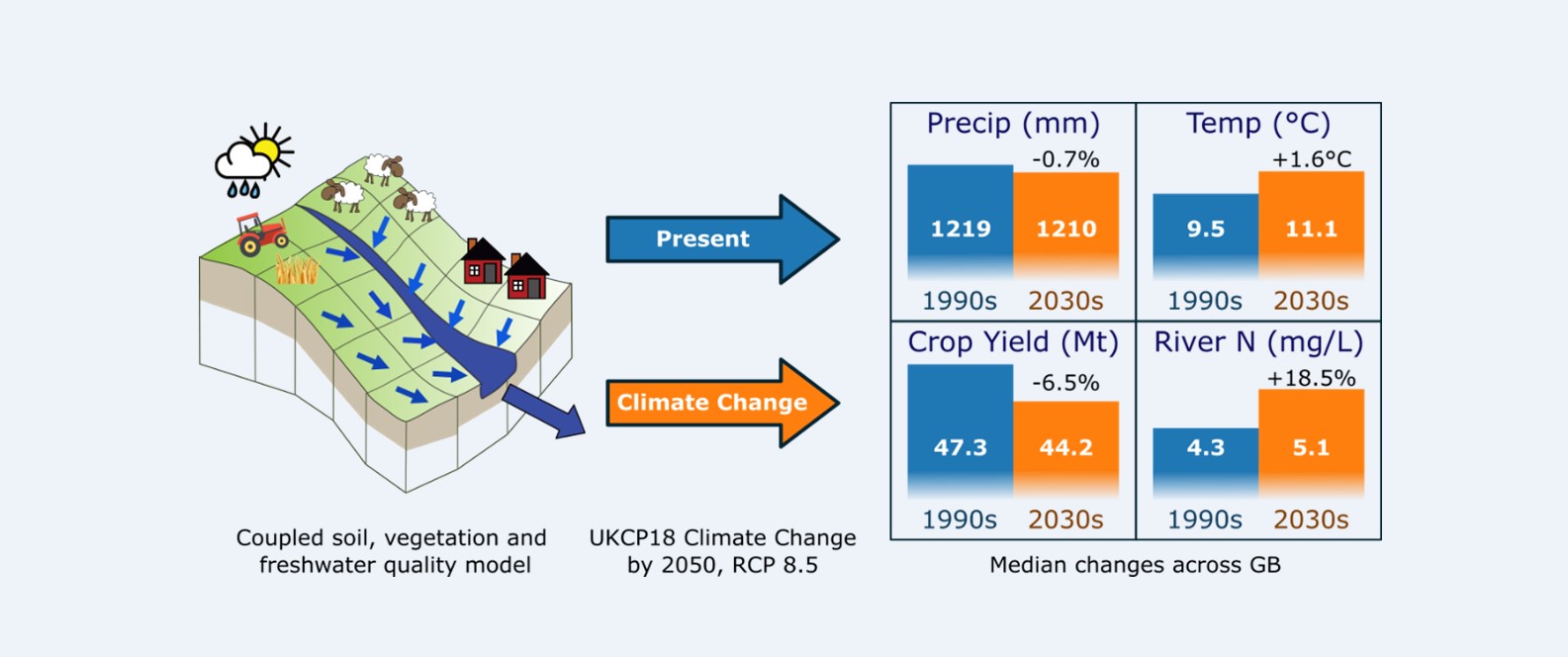
Scientists at the UK Centre for Ecology and Hydrology and Rothamsted Research have projected how future climate changes could affect freshwater quality and agriculture across Great Britain under a high global warming scenario.
Using a Long-Term Large-Scale integrated modelling framework, as part of the AgZero+ project, the study (Missault et al. 2026) focuses on the period 2020 to 2050, comparing it with 1980 to 2010. To isolate climate effects, human emissions of carbon (C), nitrogen (N) and phosphorus (P) and farm management were held constant (1980 to 2010 levels), but rainfall patterns and air temperatures were projected to change. The results show that climate change could lead to:
· A 20–30% rise in macronutrient (C, N and P) concentrations in rivers and streams
· Increased nutrient fluxes of 3–10% along the west coast and decreases of 3–13% along the east coast
· Decreases in yields of common arable crops by 5–20%, but an increase in maize yields of around 20%
Freshwater C, N and P concentrations rise mainly because lower river flows mean less dilution, as temperatures rise, crops mature too quickly, which means they have less time to grow and produce smaller harvests. The increase in maize yields (which grows better at higher temperatures), however, shows that smart crop choices and adaptation strategies could help maintain food production in a changing climate. A companion study (El Fartassi et al. 2026) using the same model explored land-management strategies alone (not climate change), finding approaches that both reduce nutrient losses to rivers and boost agricultural productivity.
Taken together, the findings emphasise the need for coordinated land and water management policies to protect both food security and freshwater ecosystems.